Restaurant payroll trips up first-time owners for one reason: tipped employees aren't just hourly workers. They operate under a separate federal wage structure — tip credits, minimum wage make-up pay, overtime rules that work nothing like standard hourly math. Get any piece wrong and you're looking at back-pay liability stretching two or three years.
The core rule: federal law lets you pay tipped employees as little as $2.13 per hour in cash wages. But if their tips don't bring the total to $7.25, you cover the gap. Every time. No exceptions. And eight states don't allow that arrangement at all.
- Federal tipped cash wage is $2.13/hr — you cover the gap if tips don't reach $7.25/hr
- Overtime is 1.5x the full minimum wage ($10.88/hr federal), NOT 1.5x the $2.13 cash rate
- 8 states ban tip credit entirely — CA, OR, WA, MN, AK, NV, MT, HI pay full state minimum wage
- Tips are taxable wages — withhold FICA on all reported tip income
- Track hours, record tips, calculate gross pay, then withhold — in that order, every week
How Restaurant Payroll Works Differently From Regular Hourly Payroll
Regular hourly payroll is simple: hours × rate = gross pay. Restaurant payroll adds one layer that breaks almost every first-time owner — the federal tip credit.

The tip credit is the gap between what you pay (the "cash wage") and the federal minimum wage. You're crediting customers' tips against your wage obligation. The rule is blunt: if tips don't cover the gap, you write the check. Always.
Take Marcus, a taco shop owner in Phoenix with six employees. He paid servers $2.13/hr and assumed tips always covered the rest. One slow January week, a server averaged $4.80/hr in tips — leaving a $0.32/hr shortfall. Marcus owed make-up pay for every hour she worked. Small number. Real obligation. Multiply it across a DOL audit and the math stops being small.
Tip Credit, Tipped Minimum Wage & Overtime: The Numbers That Matter
Three numbers drive all restaurant payroll math. These feed directly into small business payroll basics for any food service operation. Know them cold.
| Rule | Federal 2026 | What It Means |
|---|---|---|
| Tipped cash wage | $2.13/hr | Minimum you can pay in cash; tip credit covers up to $5.12/hr |
| Overtime for tipped employees | $10.88/hr (1.5 × $7.25) | Multiply the FULL minimum wage — never the $2.13 cash wage |
| Tip pooling | Servers, bussers, bartenders | Post-FLSA 2018: only employees who customarily receive tips can participate |
Paying overtime at 1.5× the $2.13 cash wage instead of 1.5× the full $7.25 minimum is the single most common — and costly — restaurant payroll mistake. The Department of Labor can pursue back pay for up to two years, three for willful violations. One audit can wipe out a year's profit.
California, Oregon, Washington, Minnesota — stop right here. The federal tip credit doesn't apply to you. Your tipped employees get the full state minimum wage. Period.

Running Restaurant Payroll Week to Week: A 4-Step Checklist
Managing payroll yourself for a team under ten? Same process, every week, same order. Don't shortcut the sequence.
The 40-hour threshold is per workweek, not per pay period. Pay biweekly and an employee works 45 hours one week and 35 the next? You owe OT on 5 hours in week one — even though the biweekly total is 80. Most new owners get this wrong exactly once before it's expensive.
Employees must report cash tips by the 10th of the following month using IRS Form 4070 (or equivalent POS records). Credit card tips come through automatically — cash tips don't. Keep everything. You'll need it for your Form 941 quarterly employer tax return.
Cash wage plus tips, per employee. If the total falls below the applicable minimum wage for those hours, you owe the difference — that week, not averaged across weeks. Document every calculation. It's your compliance record if the DOL ever comes calling. For the broader process, see our guide on how to run payroll for small business.
FICA — Social Security (6.2%) and Medicare (1.45%) — applies to every dollar of reported tip income. You withhold the employee's share, you match it. Tips are wages. No carve-outs, no exceptions. This is one of the common payroll mistakes to avoid that auditors find constantly in restaurant payroll.
Tips are taxable wages the moment your employee reports them. Withhold Social Security (6.2%) and Medicare (1.45%) on all reported tip income — and match it as the employer. Skipping this creates a payroll tax liability. Pay records must reflect real wages actually paid; falsifying income records is illegal.
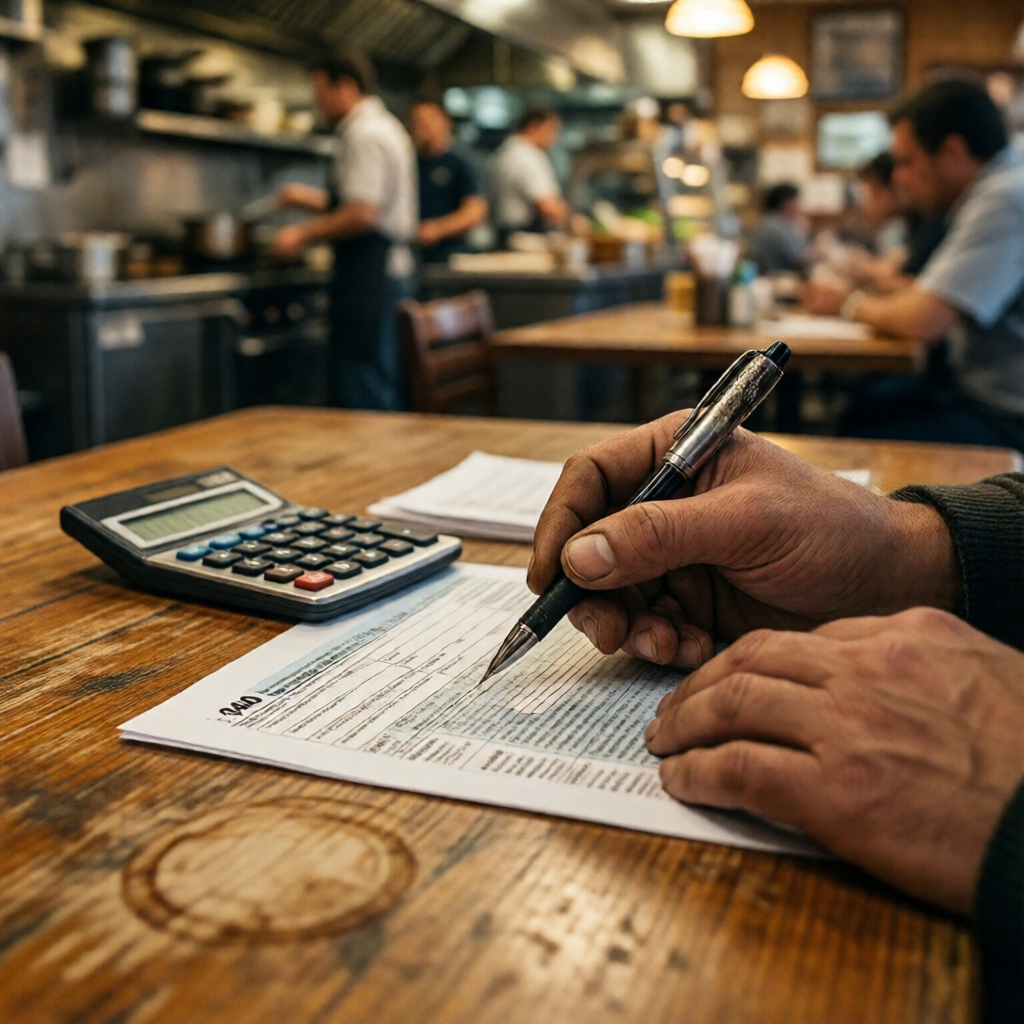
- Federal tipped cash wage is $2.13/hr — you cover any shortfall below $7.25/hr
- 8 states require full state minimum regardless of tips — verify your state every year
- Overtime is 1.5× the full minimum wage, never 1.5× the $2.13 cash rate
- Tip pools can only include employees who customarily receive tips (post-FLSA 2018)
- FICA applies to all reported tip income — withhold and match every pay period
Frequently Asked Questions
Can I pay tipped employees less than minimum wage in 2026?
Federally, yes — the tipped cash wage is $2.13/hr as long as tips bring the total to at least $7.25/hr. Eight states (including California, Oregon, and Washington) ban the tip credit entirely, requiring the full state minimum wage regardless of tips. Verify your state rate before setting a cash wage.
How do I calculate overtime for a tipped employee?
Overtime for tipped employees is 1.5 times the full applicable minimum wage — federally, that's $10.88/hr ($7.25 × 1.5). You can subtract the allowable tip credit from the OT rate, but the multiplier must be applied to the full minimum wage, not the $2.13 cash wage. Getting this backwards is the most audited issue in restaurant payroll.
Do I need to report employee tips for payroll taxes?
Yes — tips reported by employees are included in gross wages for FICA withholding. That means both the employee's share (7.65% combined) and your employer match. Employees report tips monthly using IRS Form 4070; you report allocated tips annually on the W-2, Box 8.
What happens if tips don't cover the minimum wage gap one week?
You pay the shortfall as additional wages in that same pay period. You can't average across weeks or roll a deficit forward — the obligation is calculated per workweek. Track this weekly. Document it every time.
Restaurant payroll has more moving parts than most owners expect. Nail the tip credit calculation. Get the overtime base rate right. Stay current on FICA. Those three things cover the bulk of where restaurants get into trouble with the DOL.
Ready to simplify restaurant payroll?
Generate accurate pay stubs for your tipped employees — tip wages, make-up pay, and all deductions included.
Generate Restaurant Pay Stubs Free →