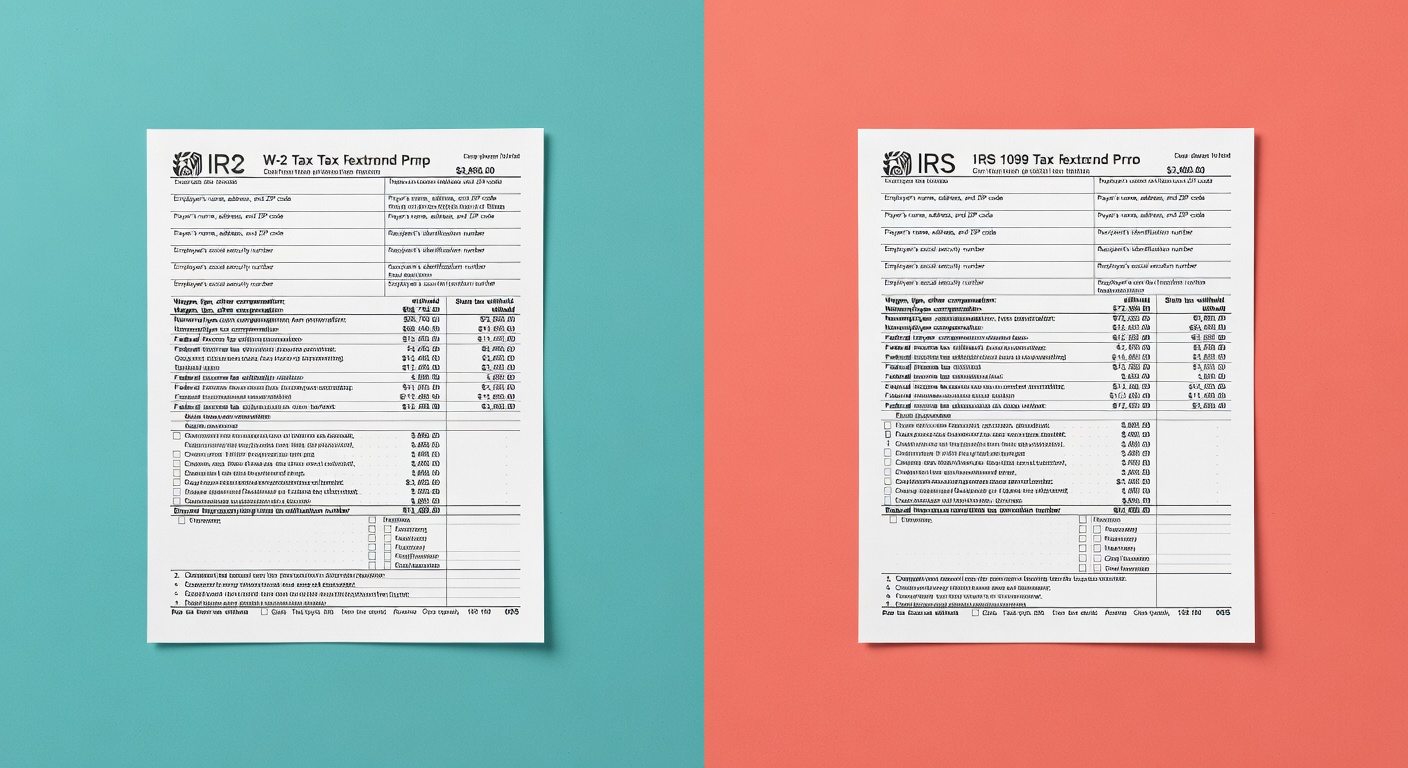
Your nanny is almost certainly a W-2 employee, not a 1099 contractor. The IRS uses three tests — behavioral control, financial control, and relationship type — and household workers fail all three for contractor status. Misclassifying your nanny can trigger penalties of 1.5% to 40%+ plus back taxes.
- Nannies, housekeepers, and caregivers are W-2 employees
- A contract or worker preference cannot override IRS rules
- Misclassification means you owe 100% of unpaid employee taxes
The Key Difference Between W-2 and 1099
The classification of a worker as an employee (W-2) or independent contractor (1099) determines who pays employment taxes and how. On paper, paying someone as a 1099 contractor looks cheaper and simpler — but it is illegal when the worker does not meet IRS criteria for independent contractor status.
| Factor | W-2 Employee | 1099 Contractor |
|---|---|---|
| Social Security/Medicare | Split 50/50 with employer | Paid 100% by contractor |
| Federal Income Tax | Can be withheld | Not withheld |
| Unemployment Tax (FUTA) | Paid by employer | None |
| Year-End Form | W-2 | 1099-NEC |
| Unemployment Benefits | Eligible | Not eligible |
| Workers’ Compensation | Covered | Not covered |
| Nanny Classification | Almost always correct | Almost never correct |
“You generally must withhold and pay Social Security and Medicare taxes if you pay cash wages of $2,700 or more in 2026 to any one household employee.— IRS Publication 926
IRS Classification Rules
The IRS uses a three-factor test based on behavioral control, financial control, and the type of relationship to determine worker status. You cannot choose the classification — the facts of the working arrangement determine it.
| IRS Test | Employee Indicator | Contractor Indicator |
|---|---|---|
| Behavioral Control | Employer sets schedule, provides instructions and training | Worker chooses own methods and schedule |
| Financial Control | Uses employer’s tools/supplies, paid regular wages | Significant investment, can profit or lose money |
| Type of Relationship | Ongoing, integral to household, no written contract as contractor | Project-based, works for multiple clients, own business entity |
Even if both you and your nanny prefer a 1099 arrangement, the IRS does not allow you to choose. The working relationship determines the classification, not a contract or mutual agreement. Filing IRS Form SS-8 lets the IRS make an official determination if you are unsure.
Why Your Nanny Is an Employee
When the IRS three-factor test is applied to a typical nanny arrangement, the result is clear across all three categories:
The same logic applies to housekeepers who come on a regular schedule, senior caregivers, personal assistants, and most other household workers who work primarily for your household.
Common Myths Debunked
Misclassification often starts with a misunderstanding. Here are the five most common myths household employers believe — and why the IRS disagrees with every one of them.
Worker preference does not determine classification. The IRS rules apply regardless of what either party wants. Even if your nanny asks for a 1099, you are still legally required to treat them as a W-2 employee if the facts support employment.
A contract cannot override the actual working relationship. If the facts indicate employment, the IRS will treat it as employment regardless of what your contract says. The substance of the relationship always trumps the label.
Working for multiple families does not automatically make someone a contractor. Each family relationship is evaluated independently. If you control when and how she works for you, she is your employee for those hours.
How you pay does not change the classification. Cash wages are still wages, and you are still required to pay employment taxes and issue a W-2. Paying cash without withholding actually increases your legal exposure.
Part-time employees are still employees. Hours worked do not determine classification — the nature of the relationship does. A nanny who works 15 hours a week under your direction is just as much your employee as one who works 40.
Consequences of Misclassification
Misclassifying an employee as a contractor is not just a technical violation — it carries serious financial and legal consequences for both you and your worker.
For You (The Employer)
| Consequence | Details |
|---|---|
| Back FICA taxes | 100% of the employee’s unpaid Social Security and Medicare |
| Unemployment taxes | Back FUTA and state unemployment for all years |
| Interest | Accrues on all unpaid amounts from the original due date |
| Penalties | 1.5% to 40%+ depending on whether misclassification was intentional |
| Criminal charges | Possible for willful violations |
| Lost tax credits | Cannot claim dependent care credit without reporting employee SSN |
For Your Nanny
| Impact | Details |
|---|---|
| No unemployment benefits | Ineligible if they lose the job |
| No workers’ comp | No coverage if injured on the job |
| Missing SS credits | Retirement benefits reduced |
| Self-employment tax | Responsible for full 15.3% FICA plus income tax |
| IRS scrutiny | Potential audit flags on their return |
The IRS uses data matching to catch household employers who issue 1099s instead of W-2s. They know that nannies earning $40,000+ from a single family are almost certainly misclassified if reported as contractors. This is one of the most commonly flagged discrepancies in household employment.
Rare Situations Where a 1099 Is Appropriate
There are a few household-related situations where a worker might legitimately be a contractor:
“The cost of proper classification is always less than the cost of misclassification. When in doubt, issue a W-2.
If you do work with legitimate independent contractors, the tax and payroll process is entirely different from W-2 employment. See our independent contractor payroll guide for a full breakdown of 1099 obligations, self-employment taxes, and quarterly estimated payments.
What You Should Do
If You're Just Hiring
Accept that your nanny is an employee
Get an EIN from the IRS
Set up proper payroll
Withhold and pay taxes properly
Issue a W-2 at year end
If You've Been Paying as a 1099
The IRS offers the VCSP for employers who want to reclassify workers going forward. You pay roughly 10% of the employment tax liability for the most recent year, and the IRS waives penalties and interest for prior years. Consult a tax professional immediately — the sooner you fix it, the lower the total cost.